
The steep cut in Customs duty on silver in the FY25 Budget to 6 per cent from 15 per cent may provide the government temporary relief by checking the spurt in silver imports from the United Arab Emirates (UAE) under the Comprehensive Economic Partnership Agreement (CEPA). In FY24, silver imports from the UAE jumped to $1.7 billion from only $11.18 million in FY23, according to commerce department data. In May, about 87 per cent of India's silver imports came from Dubai.

While Andhra Pradesh is expected to receive Rs 15,000 crore to Rs 20,000 crore, Bihar is likely to get Rs 5,000 crore to Rs 10,000 crore in FY25.

'The conspiracy is to end India's entrepreneurship culture even before it fully blooms.' 'Negativity is being spread in society towards all those who do business, and this hatred for business and wealth creators is spilling everywhere.'

'I found it unbelievable that L&T said 45,000 jobs were waiting to be filled because of unavailability of suitable skillsets.' 'So, when the Opposition sweepingly says there are no jobs, I'm sorry... I'm not saying it's raining jobs, but there are jobs. The (skill) gap has to be bridged.'

Recognising job creation for the youth as the foremost challenge for the economy, Finance Minister Nirmala Sitharaman on Tuesday announced a comprehensive Prime Minister's package to facilitate the employment and skilling of 41 million youth with a central outlay of Rs 2 trillion over the next five-year period. The package will consist of five schemes and initiatives - three focused on jobs and two on skilling.

'This year overall hiring has seen a slight improvement as compared to the dip seen during the last financial year.'

To boost domestic manufacturing under the Make in India initiative and reduce dependency on imports, the government is expected to announce in the Budget an increase in the minimum local content requirement for public procurement, with certain sectors being granted exceptions. Currently, firms producing goods, services, or works with at least 50 per cent local content are classified as Class-I local suppliers and are preferred the most in government procurement.

'There is no immediate threat to the government, and they would prefer the growth agenda.'

A lot of the 100-day programmes would be 'milestone-based' with timelines for achieving targets for social-sector schemes.

'The nominal GDP growth assumption for FY25 may be revised upwards on higher growth expectations.'

Updated new base years for national accounts and other macro-indicators are expected to come into effect from January-February 2026, coinciding with the first and second advance estimates of national income for FY26, senior official sources aware of the development told Business Standard. "The statistics ministry set up the Advisory Committee on National Accounts Statistics (ACNAS) earlier this week. "It will advise on the base year for GDP (gross domestic product) and its alignment with other macro-indicators.

A company spokesperson told Business Standard that Amazon was committed to the safety and well-being of its employees. "Disciplinary proceedings have been initiated against the people involved in the incident. "The process is underway and we are looking at a potential case of 'separation' for the people involved within the next week or two," the spokesperson added.
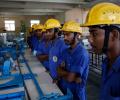
Unincorporated enterprises in the manufacturing sector lost nearly 1.8 million establishments and shed 5.4 million jobs between July 2015-June 2016 and October 2022-September 2023, an analysis of the fact sheet on 'Annual Survey of Unincorporated Sector Enterprises (ASUSE)' and the comparable 73rd round survey in 2015-16 by the National Statistical Office (NSO) showed. An estimated 17.82 million unincorporated enterprises operated in the manufacturing sector in October 2022-September 2023, nearly 9.3 per cent down from 19.7 million unincorporated enterprises in July 2015- June 2016.

The number of fresh formal jobs generated in a month increased to a seven-month high in April, signalling a recovery in the formal labour market in the country, according to the latest monthly payroll data released by the Employees' Provident Fund Organisation (EPFO) on Thursday. In April, the number of new monthly subscribers under the Employees' Provident Fund (EPF) sequentially increased by 18.77 per cent to 887,438 from 747,146 in March.

'Efforts are on to make the data readily available so that it proves useful for policymakers.'

After adding 11.7 million workers in the October 2022-September 2023 period from the pandemic lows in April 2021-March 2022, total workers employed in the vast informal sector in India - at 109.6 million - still remains below the pre-pandemic period.

'The expeditious enactment of labour codes and strategic measures to bridge the skills jobs gap are critical.'

India's current account deficit (CAD) may dip further in the March quarter of FY24 as pressure from the negative net exports during the January-March period eased to an 11-quarter high. A part of the gross domestic product (GDP) data, net export- which is usually negative for India - captures the difference between exports and imports of both goods and services, while the CAD data, released by the Reserve Bank of India (RBI), also factors in private transfer receipts.

>Bihar (18 days) has the most number of heatwave days in 2023, followed by Andhra Pradesh (15 days), Odisha (15 days), Jharkhand (13 days), West Bengal (8 days) and Tamil Nadu (6 days).

Smartphones have been a key success story of the government's production-linked incentive scheme, helping India become the second-largest mobile phone manufacturing country, after China.
 © 2026 Rediff.com - Advertise with us - Disclaimer - Privacy Policy - Sitemap - Feedback - About us - Terms of use - Grievances